
Last updated: 27th February 2026
Research shows the importance of effective employee communication in higher education, with studies highlighting a positive correlation between the quality of a university’s internal comms and the levels of engagement and knowledge-sharing among staff.
It concludes that effective internal communication in HE results in notable improvements in the teaching-learning process, a stronger culture and higher levels of employee engagement.
While it isn’t necessarily new news that effective internal communication leads to these types of benefits, it’s not always plain sailing for those responsible for IC in HE establishments as the lines are often blurred between student and staff communications. In fact, there have been calls for an improved approach to IC in universities for well over a decade now.
But as many universities begin rolling out long-term digital transformation programmes that take a more ‘people-first’ approach, the time has never been better to explore the ways that Microsoft 365 products can be optimised for internal communication.
Let’s make a start by exploring the unique challenges that IC professionals working in higher education are facing.
Internal Communication Challenges Facing Universities
For many universities, marketing and communications budgets are often channelled toward external websites and new student recruitment, leaving a notable gap where internal tools and technologies are not given the same priority. However, when you consider that almost all universities in the UK are classified as non-profit institutions, securing investment for a new intranet can feel near-impossible.
This has led to a widespread reliance on outdated and unsupported internal platforms, right across the higher education sector.
But with many of these platforms now facing ‘end of life’ and the higher education sector continuing to experience huge growth, universities need to act fast to understand what they’re up against and take action to retain and engage their staff in an increasingly competitive talent market.
Shrinking budgets, growing expectations – budgets across higher education are being squeezed, and internal communicators are increasingly having to fight for the investment they need. In many cases, this means new platforms and tools feel out of reach. The opportunity here is that much of the functionality internal comms teams need already exists within M365 – from intranets in SharePoint to collaboration in Teams and community engagement in Viva Engage. By making better use of licences that are already being paid for, universities can modernise their internal comms ecosystem while reducing reliance on legacy, costly third-party tools.
No central employee hub – one of the most significant internal communication challenges faced by universities today – and one we see in lots of our university clients – is the lack of a central employee hub. The resources dedicated to public and external marketing platforms are simply not reflected internally, creating a significant barrier to effective employee communication. Email becomes the only available channel for sharing internal messaging and leadership updates, and many departments resort to setting up their own ‘mini intranets’ within platforms like SharePoint. As you can imagine, this often leads to a tangled net of inconsistent, outdated and ungoverned legacy sites.
Technology led by IT, not comms – another common challenge we see is projects involving intranets or employee communication platforms are often led by IT or digital transformation teams. While this brings valuable technical expertise, internal comms teams aren’t always involved early enough in the process. This means decisions can lean towards the quickest, easiest or cheapest technical option, rather than the one that best supports engagement, culture and strategic messaging. Framing these programmes as a partnership between IT and internal communications helps ensure tools are selected, configured and governed in a way that genuinely meets the needs of staff, rather than simply ticking a technology box on a transformation checklist.
A dispersed and dynamic workforce – universities are juggling dispersed teams, diverse stakeholder groups and challenging targets. The university workforce is dynamic – comprising a wide range of academic and non-academic positions, staff on fixed-term contracts and hourly-paid team members. This diversity of roles, contract types and work locations presents a significant internal communication challenge, as a ‘one size fits all’ method just doesn’t cut the mustard. To effectively communicate with all staff members – from the cleaning teams to the senior professors – a targeted and segmented approach is required.
Using M365 to Transform Internal Communications in HE
Building an understanding of the unique challenges that IC professionals in higher education are facing is an important first step. And while being reliant on outdated technology that’s no longer fit for purpose is a pretty scary concept, it presents a massive opportunity to shake things up and bring new life into your workplace tools.
Let’s explore some of the best ways that M365 can be used to overcome these challenges and transform IC in a HE setting.
1. A central SharePoint intranet
While it’s true that securing the investment for a new intranet for university employees can be tricky, what if we told you that many HE institutions are unknowingly halfway there by already having access to the tools required to create an engaging and interactive intranet platform?
Microsoft 365 plays a starring role in a large number of HE digital transformation strategies, including full access to SharePoint – the perfect platform upon which to build a dynamic employee intranet that informs, connects and engages team members from right across the university. Introducing a central SharePoint-based intranet pulls everything together, eradicating the need for individual teams and departments to create their own unconnected sites that contribute to the tangled web of platforms we spoke about earlier.
A central SharePoint intranet becomes the ‘single source of truth’ for university staff, connecting different campuses, making important resources and tools easier to find and – ultimately – improving employee retention.
2. A workforce connected by Microsoft Viva
Connecting employees with each other, with the leadership team and with the university’s overarching strategy is one of the best ways to improve internal communication and boost employee engagement.
A Lecturer who feels connected, informed and aligned is going to deliver a higher quality of teaching and be more loyal to the university. A Research Assistant who knows their employer respects them enough to invest in internal workplace tech is more likely to go the extra mile with their day to day work. And an IT Manager who understands the university’s long-term strategy will feel more invested in its overall success, and less likely to seek external opportunities actively.
Viva Engage enhances workplace connection and collaboration by pulling together the digital community experience from right across M365. It elevates internal communication by allowing employees to join communities, post and pin announcements and ask questions. And it supports university IC leads by enabling them to publish posts and stories on behalf of leadership and hosting university-wide Q&A style “Ask Me Anything” events.
We spoke more on practical tips to engage university staff with Microsoft Viva here.
3. A segmented content strategy
The ability to create targeted, personalised content for different employee groups across the university is a total game changer.
We already know that the ‘one size fits all’ approach to IC doesn’t work with such a dynamic and dispersed workforce, but manually filtering every piece of content for multiple different groups just isn’t practical. Which is where Viva Connections comes in. It works hand-in-hand with your SharePoint intranet and Viva Engage to create a centralised hub where employees can access things like news, documents and university apps. It creates something that feels like a ‘front door’ to your entire digital workplace.
But now for the good bit – the content displayed on each employees’ dashboard can be personalised based on things like their job role, campus location or department. This gives IC leads the power to automatically share fully-segmented content and information that’s relevant to each different staff group.
How we Help Universities Improve Internal Comms
We’ve worked with universities including the University of Leeds, King’s College London, SOAS, Canterbury Christ Church University and Maynooth University to design internal communication platforms and strategies built on Microsoft 365. Our work typically spans the full journey – from research, discovery and stakeholder workshops, through to strategy and roadmap development, and into full intranet and wider digital workplace builds using tools like SharePoint, Viva and Power Platform.
For Leeds, this meant consolidating hundreds of legacy sites into a modern SharePoint Online intranet that acts as a single source of truth for more than 9,000 staff, with clearer governance, personalised tools and improved access to policies and core systems. At SOAS, we helped shape and deliver dual, connected intranets for staff and students, each tailored to their specific needs but underpinned by a shared Microsoft 365 foundation to support better segmentation and mobile access. For Canterbury Christ Church, we focused on strategy and planning – auditing the existing landscape and co-creating a phased roadmap toward a modern intranet aligned to their Vision 2030.
Across these projects, our role is to help universities make the most of the licences and tools they already have, bring together IT and internal comms around a shared vision, and create people-first digital environments that make communication clearer, more consistent and easier to manage over time.
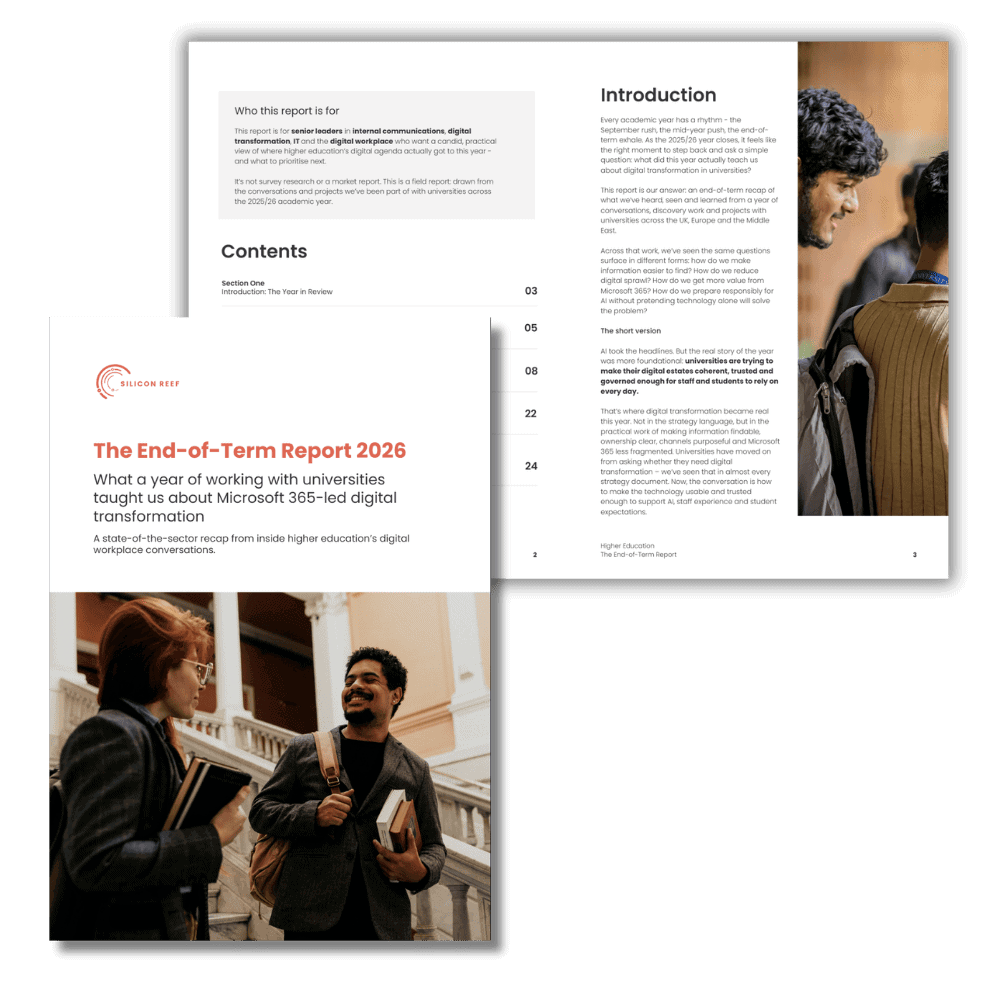
End of Term Report 2026: What a Year of Digital Transformation in HE Taught Us
Insights from a year of conversations and projects with universities across the UK, Europe and the Middle East – including the trends shaping digital workplaces across the sector, how universities are addressing key challenges and a look ahead to the future.