
Key Takeaways
- AI community agents in Viva Engage are context-aware assistants that suggest verified answers, summarise threads, surface existing content to prevent duplication, and flag knowledge gaps – turning communities from reactive message boards into proactive knowledge hubs.
- Internal communicators shift from publishers to curators: instead of re-explaining the same core messages, IC teams can focus on tone, voice, and culture while AI handles repetition and routes employees to verified, trusted answers.
- Two-way dialogue can now scale without losing control – agents manage flow rather than mute voices, reducing misinformation in HR and policy spaces, cutting duplication in IT forums, and keeping leadership AMAs and change programmes consistent.
- Silicon Reef views Viva Engage as the “modern knowledge layer” for organisations, where everyday conversation becomes searchable, reusable insight – and AI community agents are the practical step that makes that vision scalable, preserving organisational memory while keeping humans focused on empathy, judgement and meaning.
Microsoft’s latest update to Viva Engage introduces a powerful new capability: AI community agents. These intelligent, automated assistants are designed to help community managers and internal communicators scale their engagement, reduce repetition, and turn everyday conversation into structured, trustworthy knowledge.
So what exactly has changed?
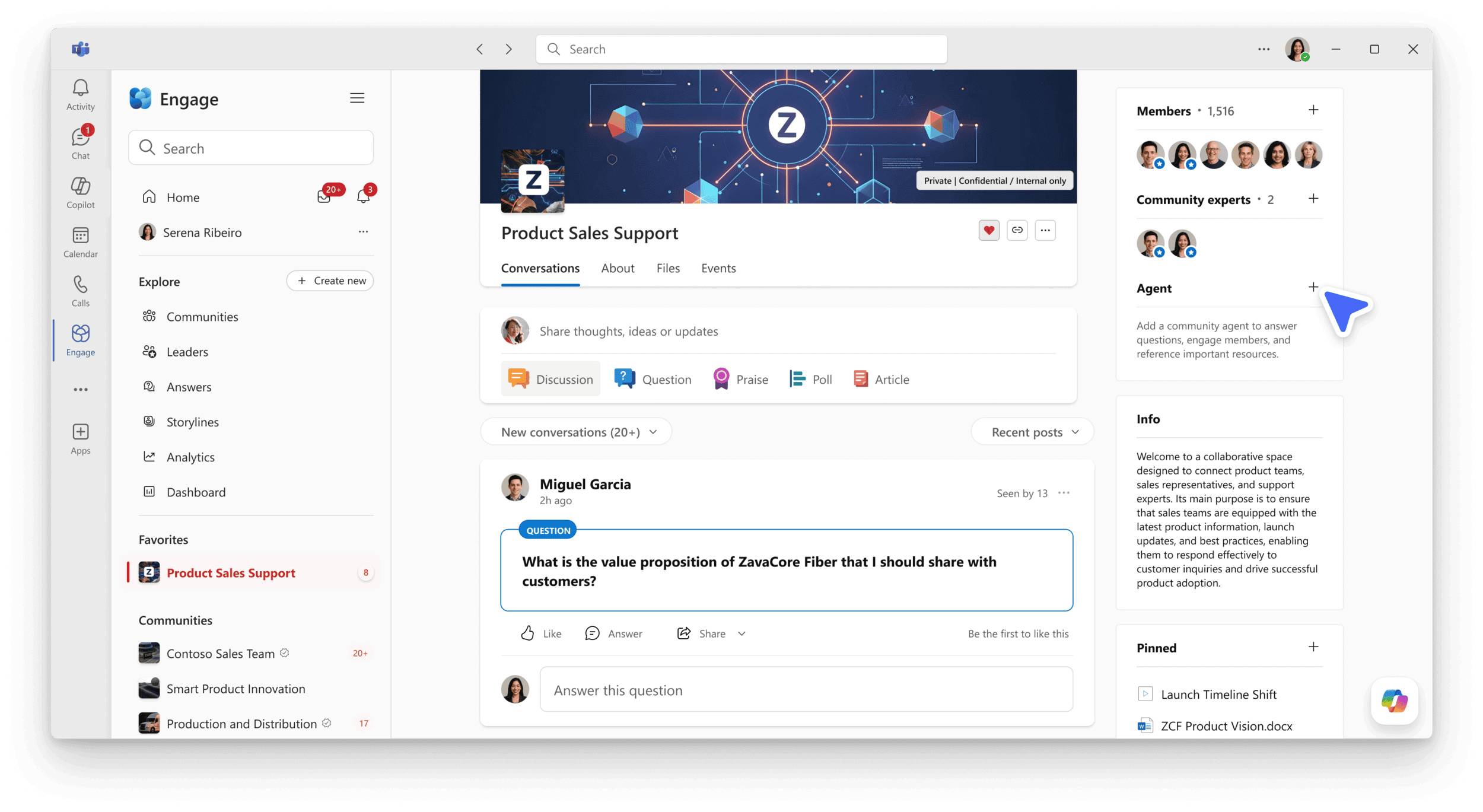
AI community agents are embedded within Viva Engage communities, and they act as context-aware assistants that can:
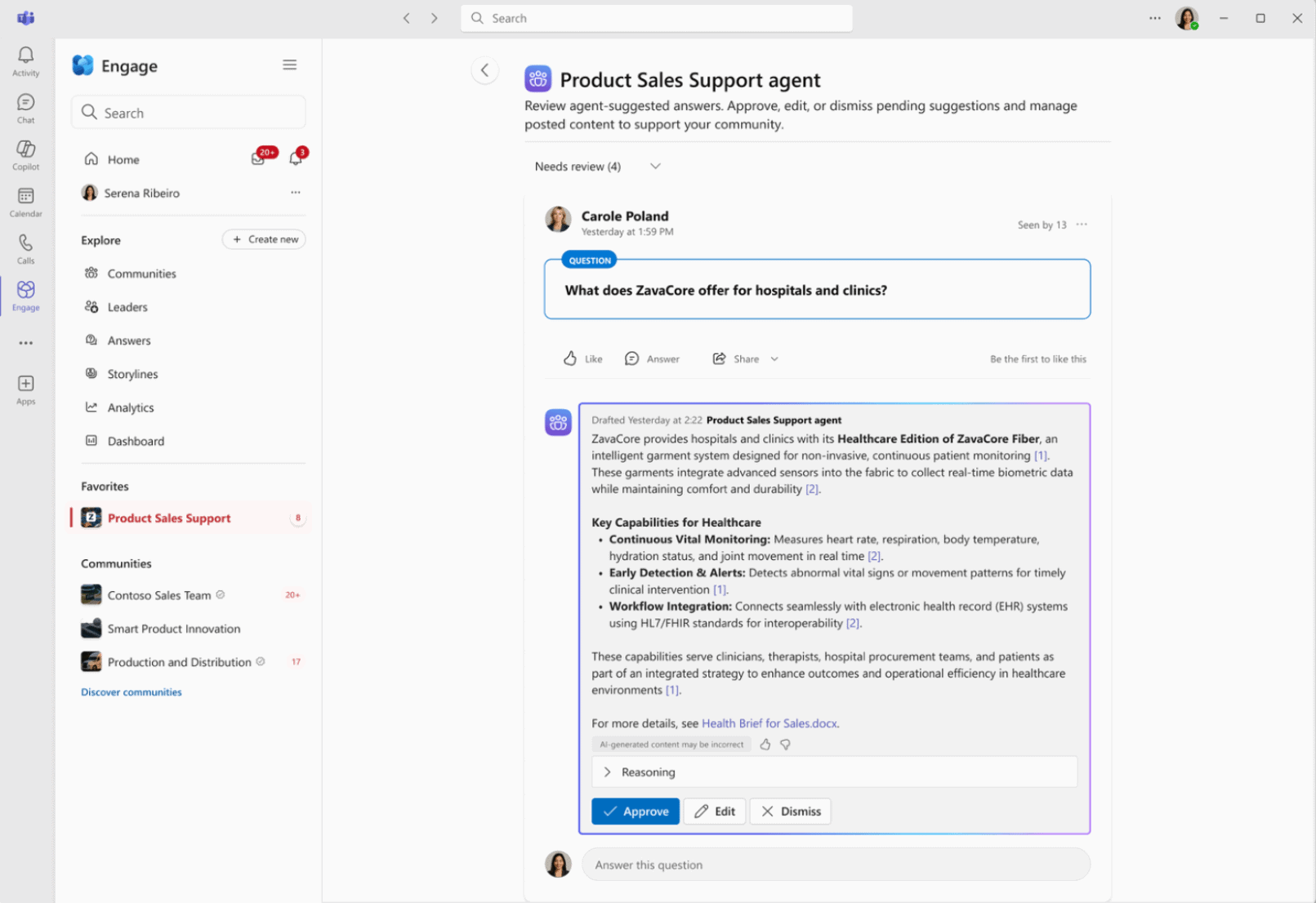
- Suggest verified answers to frequently asked questions.
- Summarise threads and mark best responses automatically.
- Surface and search relevant existing content before a new question gets posted, avoiding duplication.
- Flag emerging themes, unanswered questions, or knowledge gaps.
- Support moderators and communicators by making community management faster and more consistent.
They transform community spaces from reactive message boards into proactive knowledge hubs. They don’t take over the role of community managers; they make it easier to do well. By taking care of routine tasks and keeping discussions consistent, agents create space for communicators to focus on quality, tone and purpose. This update marks a practical step forward in how internal communication will scale and evolve across Microsoft 365 in the years ahead.
At Silicon Reef, we like to think of Viva Engage as the “modern knowledge layer” for organisations: a place where human conversation becomes searchable, reusable insight. Not just ‘social media for work’.
This update takes that promise and scales it sustainably.
From Publishing to Curating: A New Role for Internal Comms
Internal communicators have traditionally been publishers – responsible for producing the content that informs and inspires. As organisations grow, that job becomes harder. The real bottleneck for Internal Comms now lies in the sheer volume of knowledge circulating informally through chats, Teams, and community conversations. That information is valuable, but hard to capture and reuse at scale.
AI community agents help change that dynamic.
Instead of spending time writing, chasing, and re‑explaining the same core messages, IC teams can now focus on curating. Viva Engage evolves from a space for announcements and book-club-chat, into a platform where you can uncover the knowledge already inside your organisation and make it accessible.
Existing Engage features – structured Q&A, topic tagging, and verified answers – were the foundation. AI now layers intelligence on top, keeping those assets clean, consistent, and visible.
Imagine an “Ask HR” community. Before, HR teams might face dozens of versions of the same question (“What’s our hybrid policy?” “Can I work remotely 3 days a week?”) Each answer risks being slightly different. Now, the AI agent can point employees to the verified response, mark it clearly, and even suggest that answer in future threads. It leads to clearer conversations, stronger trust, and a smoother employee experience with no extra work required.
For IC leaders, this shift means time back. Time to shape voice, tone, and culture rather than firefight endless Q&A. It’s a move from publishing what people need to discovering what they already know and guiding them to it.
Scaling Dialogue Without Losing Control
The biggest fear I often hear when organisations are opening up large-scale digital conversation is losing control. The idea of hundreds or thousands of employees freely posting questions, ideas, and critiques can feel unmanageable for communicators whose responsibility includes protecting the organisation’s tone and trust.
AI community agents in Viva Engage help restore that balance. They help to manage flow, rather than mute voices. By recognising when a topic already exists or highlighting trusted responses, they keep discussions healthy without imposing heavy moderation.
That has practical value across all kinds of communities:
- In HR or policy spaces, AI prevents misinformation by directing people to verified answers or official guidance.
- In IT support forums, it reduces duplication and ensures consistency in technical help.
- In change programmes, it helps maintain alignment by promoting agreed‑upon responses to repeated questions.
The outcome is scalable two‑way communication that maintains confidence and coherence. IC teams can now open the door wider without feeling they’ve lost the keys to the room.
Supporting Leadership Without Adding Work
Leadership communication is one of the biggest challenges I hear from IC teams. But it’s one of Viva Engage’s most distinctive strengths. Storylines, Leadership Corner, and AMA formats have helped leaders communicate directly, in their own voices, to distributed teams.
But maintaining presence in these spaces takes effort, especially when similar questions and comments appear repeatedly. AI community agents bring practical efficiency here too.
In a leadership AMA, for example, the agent can flag duplicate questions, group similar themes, and streamline follow‑ups. It might suggest that employees review an earlier response before posting, or summarise the most common sentiment so leaders can focus on what matters most.
For communicators who support leadership visibility, this matters hugely. It means executives can stay engaged without feeling overwhelmed, and IC teams can sustain the conversation without constant intervention.
These tools don’t create messages on a leader’s behalf; they make the leader’s own words go further. By resurfacing existing posts and managing repeated questions, they free up time for meaningful engagement on new ideas and pressing issues.
A More Grounded Story About AI
Internal communicators are rightly cautious about technology hype. Many have seen tools sold as silver bullets that ultimately complicate workflows or dilute human connection. AI community agents represent something more measured.
They don’t replace communicators – they just remove the repetition that gets in the way of meaningful communication.
By managing repeat questions and surfacing existing knowledge, the system frees communicators to focus on empathy, judgement, and strategic narrative. The parts of communication that machines can’t do.
It also preserves organisational memory. Every conversation, every verified answer, every shared insight becomes part of a searchable, living network of understanding. What used to disappear in chat threads or emails now becomes reusable knowledge, validated over time.
The Bigger Picture: Viva Engage Maturing Its Purpose
Taken together, this update signals a shift in Viva Engage’s purpose. It’s moving from social engagement to knowledge enablement - from a channel for conversation to a foundation for collective insight. I’ve spoken about turning conversion into knowledge with Viva Engage for a while now, so for me this development is a big step in the right direction.
That transition aligns perfectly with the direction modern Internal Comms is taking. The focus has shifted from speed of delivery to depth of understanding. AI community agents support that shift by helping teams build clarity and shared meaning while maintaining trust and reducing noise.
For communicators, that means Viva Engage is no longer just “another place to post.” It’s a strategic space to build culture, sharpen transparency, and grow community expertise. It’s where people connect not just with each other, but with the knowledge that helps them do their jobs better.
Final Word
Microsoft’s introduction of AI community agents in Viva Engage represents a practical leap forward for internal communication. Some might see this as another flashy feature. For me, it’s a thoughtful evolution that helps teams scale conversation, improve consistency, and capture the insights already flowing across their workforce.
Personally, I see this as a turning point. Conversation, culture, and knowledge can finally align around a shared goal, helping people find clarity without increasing workload.
AI handles the repetition. People handle the meaning. Viva Engage becomes the heartbeat of a smarter, more connected organisation.
Webinar
AI Intranets, Made Real
Watch the session for practical use cases and a live demo showing how agents turn a static intranet into a space where employees self‑serve answers and get work done.