
Key Takeaways
- Prompt training alone isn’t a reliable AI strategy for internal communications teams because AI outputs still depend heavily on each employee’s communication style, confidence and prompting ability.
- Microsoft Copilot agents can improve consistency by applying predefined context, tone of voice, data sources and governance to repeatable internal comms tasks.
- AI agents help create a more equitable experience by reducing reliance on direct, business-like prompting styles that may disadvantage some employees.
- For senior IC leaders, the strongest use cases for agents are repeatable, process-heavy tasks where consistent, auditable outputs matter more than individual experimentation.

The IOIC Impact Brief this month flagged something that surprised me – we’re way too polite! 71% of UK AI users are polite to their chatbot…and why shouldn’t our human nature be to say please and thank you when asking someone to help us? But the report shows being too polite could be giving us less accurate results – which opens up a whole new question. How do organisations control the quality of AI outputs when every employee is bringing their own communication style to the prompt?
Over the last year, most of us have gotten comfortable prompting and using basic AI chatbots. But, the stats show we’ve hit a turning point. How we communicate with AI is now a fundamental business decision, and it can’t be left down to individual prompting choices.
In my role as Head of Client Experience at Silicon Reef, I hear first-hand the conversations that are happening about AI across our client base. Nearly everyone’s story is the same. People are experimenting with AI, and results are often impressive in pockets. But the outputs are wildly inconsistent. Not because the tools are inconsistent. Because the people are.
Prompting is personal – and that’s the problem
How you prompt an AI tool is shaped by how you communicate naturally. Your personality, your cultural background, your level of digital confidence, whether English is your first language, whether directness comes naturally to you.
None of those are neutral factors, and none of them disappear when you open Microsoft Copilot. I started my career in corporate New York, and those experiences will inevitably shape the way I prompt and the outputs I get, versus my colleagues whose careers have been based in the UK.
The IC Impact report quotes Penn State professor Dr. Akhil Kumar, who says the optimal approach is “very business-like and specific to the point.” That style works well for some people. For others it’s unfamiliar – and that’s not a skills gap you can close with an afternoon training session.
What this means in practice is that a cautious HR manager and a digitally confident marketer can run the same task through the same tool on the same day and get outputs that are miles apart. For personal use, that’s fine. For business-critical, repeatable work – drafting comms, maintaining tone of voice, running standard IC processes – it’s a real organisational risk.
Right now, the quality of what people get from AI depends heavily on their individual prompting ability. That’s an uneven playing field built into the very tools we’re encouraging everyone to use.
What I’m hearing from clients
The conversations I’m having with senior IC professionals are following a familiar pattern. Enthusiasm is on the up – real experiments happening, time being saved. But when topics like consistency, governance, and measurable outcomes come up, there’s often a pause.
How do we make sure the CEO’s weekly update sounds like the CEO, regardless of who drafted it? How do we trust that the monthly sentiment analysis draws on the same data and channels every time? And crucially, how do we demonstrate ROI beyond individual time savings?
These aren’t small questions. As the report points out, fewer than a third of decision-makers can currently tie AI’s value to their organisation’s financial growth, and a quarter of planned 2026 AI budgets are expected to slip to 2027. The boardroom language that’s gaining traction is shifting from volume and velocity to governance, accountability and measurable outcomes.
Individual prompting strategies, or cumbersome prompt libraries can’t answer those questions.
Agents can.
What an agent actually changes
In the simplest terms, an agent has a pre-defined job. The thinking – the framing, the context, the tone, the data sources – goes in once and is applied consistently every time after that.
In other words, you don’t need to rely on prompts for a consistent output.
A well-defined, well-governed agent runs the same job, the same way, every time. Often autonomously, on a trigger or a schedule. You don’t need to prompt it at all.
For those who joined our workshop at the IoIC Festival this year, you will have seen we talked about exactly this. The critical distinction between standard Copilot Chat and an agent is that an agent already knows the job and your context. With Copilot Chat, you start every conversation from scratch, and the output quality depends on whatever prompt you happen to write that day. With an agent, you get the same quality output every single time – regardless of who triggers it, what mood they’re in, or how naturally the direct, business-like register comes to them.
Some of the agents we’re speaking about with IC teams show exactly what this looks like in practice. For example, an exec voice agent that drafts a weekly CEO digest in the leader’s actual voice, grounded in real business data, every Monday morning – not dependent on whoever happens to have the skills and headspace that week. A sentiment agent scanning Viva Engage daily, flagging what needs attention, with no manual prompting required.
We all know by now that AI can pick up the heavy, manual work that eats away at your week – the reformatting and re-posting of content across channels, the hours of data analysis. Agents handle all of it, identically every time. That frees up the team to do the work that actually requires human judgement.
The equity argument
This is the part I find most compelling, and I don’t think it gets enough airtime.
The “business-like, direct” prompting style that gets the best AI outputs isn’t a neutral standard. It maps naturally onto certain communication styles and backgrounds – and less naturally onto others. Non-native English speakers. Neurodiverse colleagues. People from cultures where that level of directness isn’t the norm. Less digitally confident employees. These groups aren’t bad at AI. They’re being disadvantaged by a system that rewards a particular way of communicating.
From the relationship I have with many of our clients, I know that IC professionals care deeply about equitable access to information and tools. Agents extend that principle into AI. The expertise goes into the design once. Everyone who uses it gets the benefit of that expertise, regardless of how they’d naturally phrase a request.
For a function whose job is to make sure everyone has access to what they need, that matters.
Where this points
If your organisation is planning to get maximum value from AI in the next few years, you don’t necessarily need to train an army of AI-confident individuals. But, you do need to progress from “everyone experiments with prompting” to “we’ve defined specific AI roles with consistent, auditable output.”
Crucially, that’s not a story about replacing human judgement. The IC work that requires strategic thinking, empathy, and genuine insight – the work IC professionals are increasingly being asked to do at leadership level – stays with people. But the repeatable, process-heavy groundwork? Agents handle that more consistently, more equitably, and with better governance than individual prompting ever will.
The question I’d put to any senior IC professional right now is a simple one: what are the repeatable tasks in your team’s week that depend entirely on whoever happens to be doing them? Because that’s exactly where an agent belongs.
Find the original IoIC article here.
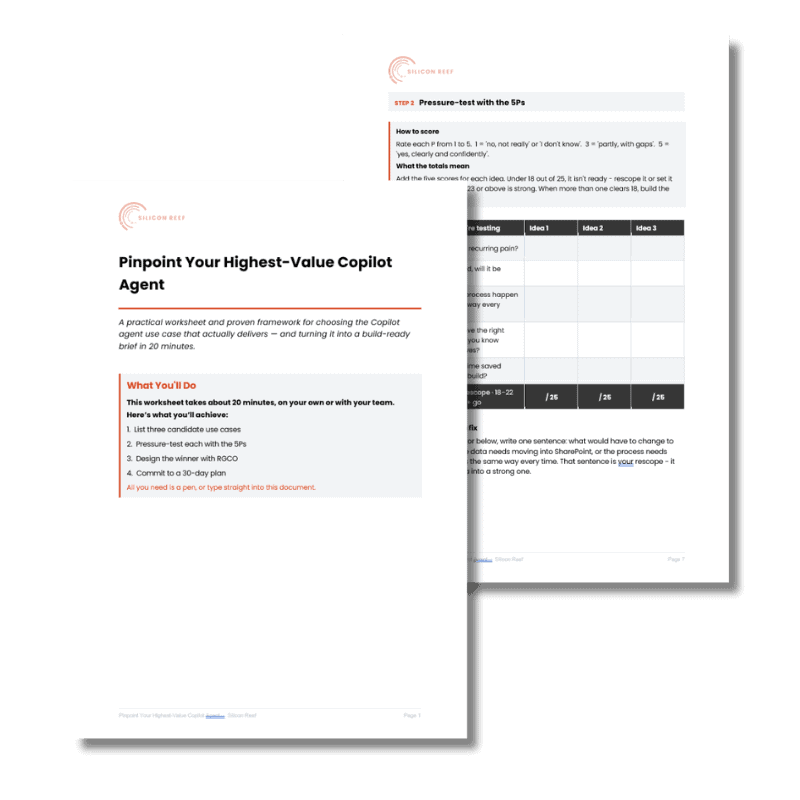
Practical Worksheet
Pinpoint your highest-value Copilot agent
A practical worksheet to find what’s worth building — and shape it fast
Most teams don’t struggle with Copilot but choosing what to build and where to start. This free 20-minute worksheet helps you pinpoint one high-value use case and turn it into something you could actually deliver.