Making Sense of the Noise:
How to Keep Your Intranet Useful, Trusted and AI-Ready
About
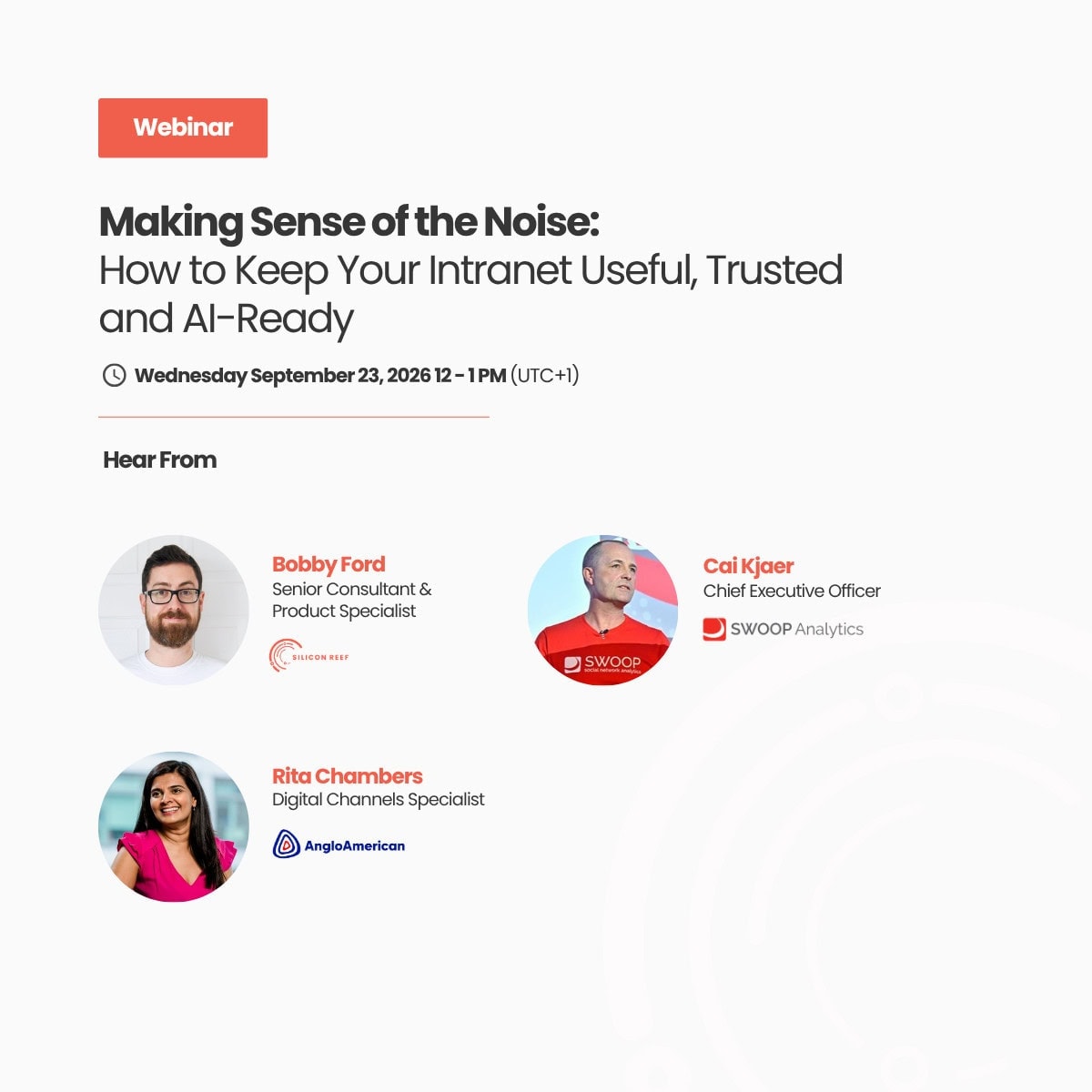
As SharePoint intranets grow, outdated pages, duplicate files and unclear ownership make it harder for employees to find answers they can trust. They also weaken the content foundation that Microsoft 365 Copilot and AI agents rely on. In this webinar, Bobby Ford from Silicon Reef is joined by Rita Chambers from Anglo American and Cai Kjaer from SWOOP Analytics to explore how organisations can reduce intranet noise, improve search and make content governance sustainable.
Watch the full webinar here or sift through the transcript here.

Transcript
Bobby Ford
Good afternoon, everyone. I think people are still joining. As you are here, good afternoon. I’ll give it a minute or two before we get started. But the so couple of bits while we while we wait for other people to join. Maybe I’ll do the housekeeping stuff now and then. Those who join. can pick up where we are without need to be going over it again. a couple of its housekeeping. We’ll have the Q&A open, so please use that. Feel free to drop any questions that you’ve got in there. We’ll pick it up as we go throughout the conversation, if we can, or at the panel section at the end.
If we don’t get time to answer your question, we’ll answer it and we’ll send the answers around to all the questions asked tomorrow with the rest of the stuff. There’s a couple of polls that we’re going to ask as we go through. There’s no right answers. They’re just here to see how your experience matches with the patterns that we’re discussing. Reactions, if something feels painfully familiar, thumbs up or a laughing reaction or something just to keep us all going. be appreciated. I don’t know if the settings are on, but if you are able to go camera on, please do. It’s always nicer to feel we’re talking to a group of people rather than some initials on a screen.
We’ll keep that going throughout the session. I think if everyone’s happy, I will kick off and get us going. People will join as they can. Thank you. OK, cameras are blocked otherwise. OK, we’ll just talk to the initials and we’ll know that you wanted to be on camera, even if even if it can’t be for this one. Next time, we’ll have all your faces on the screen. Great. Well, thank you, everyone. Oh, thank you. Speaking of faces on the screen, there’s my face on the screen. Thank you for joining. I’m Bobby. I’m from Silicon Reef. I’ll be hosting the conversation today. We’ve got Cai from SWOOP Analytics and we’ve got Rita from Anglo American.
I’m really excited that we’ve got these speakers together. we’ve known the SWOOP team for a few years now. Through conversations with them, we’ve seen a lot of similarities in the way that we think about things. we share the opinion that analytics and technology can be a really valuable thing, especially when people see where the attention is needed, and then the analytics can be used to support them, do something useful about it. we’re really excited to be having that conversation with them. today. Rita and the rest of her team at Anglo American have been working with us for, again, many years on a number of projects together.
Rita is going to be bringing in that reality of managing these things in a complex organization. Cai is going to bring in some evidence from their benchmarking. then I’ll do a bit of. It’s called consulting stuff at the end around what makes governance, ownership and content management more sustainable. We’re talking about something I suspect is going to feel pretty familiar to anyone who’s working with intranets or in a digital workplace at the moment. it comes down to the fact that intranets don’t normally become difficult overnight. They grow gradually with more sites, more pages, more documents, more people, more channels. is always for sensible reasons.
But that can create uncertainty over time. I can’t find what I need. Is this the latest version? Does this apply to me? Is it even the right answer? that’s the thread that we’re going to follow today from the three different angles. We talk a lot about being AI ready at the moment as well, and I think it’s worth being clear what we mean by that here. This is not an AI product demo, don’t worry. This is a thread throughout the conversation. Copilot and agents and all of that stuff make it even more important to have this information in your internet as current. authoritative, structured, properly permissioned, all of that good stuff.
But everything we’ll talk about today matters whether you’re already pursuing it or whether you’re just trying to make your internet a bit more useful and a bit more trusted by your organization. I’ve covered some housekeeping already. Emma, let’s jump straight into the first poll. I’ll share these slides with you afterwards so you can go back over them. But for the first poll, I’d like to ask how confident you are. that employees can find the right information on your intranet. And… anything from very confident to we don’t really know. Pop your answers in there. Give you a couple of seconds, have a think about it. Maybe a gut instinct that you can go straight to. We’ll come back to the results of that later on. Confidence is quite an important word here, and… When we’re talking about confidence on an intranet, we’re talking about whether it’s the difference between someone finding something and feeling that they found the right answer. They’re not necessarily the same thing. with that very subtle link, I’m going to bring Rita into the conversation. we’re going to have a look at what that could mean in practice. I thought I’d start by saying, Rita, thank you for joining us. what do you, what does keeping Eureka, your intranet, what is it keeping it useful and trusted look like Anglo American?
Rita Chambers
Hi, thank you, Bobby. Thanks for the invite as well for the webinar and welcome to everybody that’s on the call today. That’s a very good question, Bobby. I think for us as a big global mining company, it’s about helping people in the various different environments around the world to actually access the information that they need. to access the content that they need, as well as the news information and anything transactional to fulfil their daily roles. with that in mind, I think what is important is for them to actually feel that in align with the content that’s on there, the search results that people actually see understanding and appreciating the work that happens behind the scenes.
us as admins, the work that we put towards the content audit and, looking and reviewing the metrics to understand what’s working and what’s not. I think that is the continuous investment in the actual intranet is what helps us to make our site trusted within the company. I know that’s going to be the theme within what I’m going to cover today. hopefully that’s answered your question a little bit. So
Bobby Ford
It’s great, yeah.
Rita Chambers
Thanks, Bobby. before I get embedded within my slides here, and I will try to keep these quite quick, I’d you all just to submit one word within the chat, which tells and explains your experience of your search on the intranet. one simple word and we’ll come back to that shortly. yeah, thank you. Bobby, next slide. I know you’re controlling the slides. for those of you who’ve not heard of Anglo American, we’re a big global mining company. Here are some of the products and minerals that we actually produce. We’ve been around for over 100 years. yeah, we operate in over 12 countries. We’ve got different sites, different languages, different working patterns.
That basically means we’ve got lots of different digital realities around the world. that is really important for us to consider when we are looking at our digital landscape. Bobby. I sit within the digital team, some of some of you are on the call today, so hi guys, within the corporate communication team and you can see some of our main digital internal channels here. But for us, for the focus of this session, we’re going to be talking about our SharePoint intranet site.
Whilst as admins, the content that we share across these multiple sites is very similar, when we are tailoring content per channel, what is important to remember is each individual channel, depending on the type of content that we’re publishing, will determine how trustworthy the content becomes. something just to bear in mind, but this is our digital ecosystem, so you can see what we’re dealing with as a company internally. Thanks, Bobby. So,… This is Eureka. Eureka is the name of our SharePoint intranet site. It’s been around since about 2016, I want to say. We’ve got over 40,000 colleagues accessing Eureka. It’s managed centrally by Group Communications and also IM.
We’ve got You can see the stats there. We recently completed a channel audit this year and Eureka fared quite positively in that channel audit. You can see there 76% said that they actually, it’s the most frequently used channel. it came back very positive, but we know there is still some work to do with Eureka. Will we? The main purpose for Eureka for us is essentially to fulfil 2 roles. It needs to tell the corporate story, but it also needs to help people act and the more transactional side of Eureka. how do they access their policies? How do they book leave, etc.? Our audience will arrive with a task to complete.
They don’t have a site map, essentially, as to what Eureka looks like and where they can actually find things. over the years, we’ve naturally seen that people are using search more. whilst SharePoint still has the usual search challenges, We know that our employees, the way they engage with search outside of work is the behaviour they expect inside of work. increasingly with Google searches and the likes, and also with AI searches now. the question is, can SharePoint keep up with that? Pugh. just on the audit that we did this year, so we completed some focus groups. You can see there, we’ll take what’s working well, that’s all positive there on the left.
But what we really need to focus on is what’s not working so well on the right there. you can see there, the navigation, search, It’s more transactional than and versus engaging. it’s very similar to what we’ve been hearing in the industry for over the last, 10 years in the SharePoint intranet world. Clearly, this indicates there’s still a lot of noise and within the group content, the functional content, then there’s business content. There’s a lot of different site architecture going on on our intranet site. if people are struggling to find what they’re looking for, that clearly reduces the trust and the confidence in our intranet site.
I’m just going to quickly look at some of the feedback in the chat here. when I ask you to describe your intranet search experience, we’ve got challenging. poor, confusing. Someone said easy, so that silicon reef, the Wild West, yes, we’ve all heard that before. these are, I’m glad it’s not just us. Whilst we’ve got positive feedback on our intranet site, we still recognise that there is work to do. Bobby. this slide is basically talking about the general employee experience. We’ve all been in that team meeting, right? When someone says, oh, it’s on the intranet, you’ll find it there. then you have that immediate reaction, oh gosh, is it on the intranet? It better be.
We’ve all had that scenario. we know it’s there, but will they be able to find it? For the end user, they’ve still got that same core 3 employee expectations. Show me what matters to me, help me locate it quickly, and basically just tell me whether I can trust this content. If I download this form, if I access or content, contact this person is can I trust it? Is it right? Is it going to help me fulfil my goal here? employees, I think it’s important to recognise that employees search using the language of their particular question. But often organisations are encouraged to actually publish using the language of our structure.
I think there is sometimes credit in actually stopping and answering that question within the comms roles or as admins. to actually understand because those two scenarios can lead you to a different place when you’re looking and navigating for content on your intranet site. A week. if we actually just move away from the front end experience and actually what goes on behind the scenes. for us as admins, we should be asking who actually owns the page, who reviews it, when it should be archived or deleted, whether it should stay, and what happens when the owner changes roles. Every page has an owner until the change, they change roles, right?
Or they leave the organization, they become too busy to review it. But where does that leave the end user? Where does that leave our colleagues when they’re actually looking for content? The risk of actually accessing out of date content, contacting the wrong person, we all know that just leads to a massive rabbit hole, it just leads to more and more questions. A user comes to answer one question, they might leave with five others, right? it’s something to bear in mind as within our roles as admins. Bobby? we can probably all also relate to this scenario. Search, it’s not just the box anymore. It might have been 10 years ago, but definitely not the case now.
Our users will come to our intranet with a particular question to resolve. whether it’s how do I access the latest travel policy, book leave, etc. the search will churn out lots of different results. It will lead to confusion. But the risk essentially is to the employee if they click on the wrong link or the outdated link because it appears higher up in the search results. What does that actually mean for our intranet? Does that add to the Noise? I would say yes. we can work on the different results that people see in terms of trying to eradicate that risk by restructuring the content. We can look at changing the wording, reducing the duplication of content. It might be a permissions thing.
Search doesn’t necessarily create clarity. It basically reveals whether clarity already exists on the site or not. that’s something that we have to bear in mind. Bobby? a little bit on analytics here, because I know that’s going to be Cai slot. For us, analytics, yes, they’re useful when it helps to make a decision, but it’s not just simply about having a sexy looking dashboard, right? We can see the search terms, we can see what the zero results searches were, what the popular pages were. What content is being ignored? But those are all signals. The more important questions are, did the employees find the right answer? Did they trust it? Did they actually complete what they wanted to do?
Do you think they would come back, right? That is where I think analytics needs to be combined with both. employee feedback, usability testing, and real life examples. I say this often, the numbers will tell you where to look, but it’s the people that actually tell you what it means. that, I think, is the practical response, which might be to rewrite things, understanding how we can change it to make it more user friendly, and it’s a combination of whether we’re measuring activity or whether or not employees get something done or not. I think this is why AI readiness is not just about a technology question.
It depends also about the content behind the answers, making sure are they clear, are they current, and can we trust them? Bobby. from an AI perspective, I think this is about AI changing the question from where the information actually is to what the answer actually is. Search has done that for many years now and actually highlighting and surfacing results, but now it’s whether or not I can take this content to resolve what I’m here for. we need to ask ourselves if we would not confidently recommend a page to a colleague, should we be using AI and trusting AI to use it as a source? I think that’s the question in hand here. AI readiness starts with content people can locate, understand and absolutely trust. Bobby. I’ve got one clear takeaway for you guys today. I’m going to leave you with a recommendation that I’ve got. If you choose one high value employee question and test this journey as if you were a new starter, I would absolutely use these five questions. Is it current? Is it locatable? Is it explicitly owned by someone? are they accountable for that content? Is it authoritative? Is it trusted? Do we know that we, if we rely on it as an answer, are we going to, have any repercussions on that? is it ready for review? will it be checked? Will it be part of some audit on a regular basis on the intranet and so forth?
If you were to take one high level question, for example, how to apply for a job, what’s the working from home policy in the London office, how do I report a safety incident? If you go from your homepage and try to answer one of those questions, Do you get to the end result? Is it trusted? Is it correct? Is the contact information correct? then repeat and take those high level scenarios and make sure that actually from start to end, are we getting the right answers on the intranet? finally, Bobby. The content is not simply useful just because it’s been published. I think for us at Anglo American, the governance is a big part of our employee experience.
The AI readiness, as we’ve mentioned, whether people can locate and trust the content is one part, but that all contributes to the wider governance. again, for us, that governance is a key piece across all of our channels. our experience currently with Eureka shows that whilst the internet noise is what we talk about and it can lead to uncertainty, is something that throughout consistent auditing, reviewing, training, is something that we can try and tackle. as we go forward. yeah, that’s it from me. Thank you, Bobby.
Bobby Ford
Thanks, Rita. Really interesting to hear how that plays out in practice. I wanted to come back to one point that you made, that behind every page, there’s a promise that somebody is looking after it. I loved the way you phrased that. Briefly, though, what’s harder in practice? This finding the owner in the 1st place. or keeping that ownership alive as roles and priorities and the intranet changes.
Rita Chambers
Good question, Bobby. I think for us, I would say identifying the correct users and the admins in the 1st place. As part of our governance for each site on Eureka, we ensure that there’s at least two admins. again, so it’s important for us to maintain that. we train them, we make sure that they are like fully versed with our governance, we make sure that, they’re involved with our auditing.
If they change roles and they moved on, for example, once we get to our auditing part, once we get to our audit, content audit, that would be an opportunity for us to identify them because sometimes unless someone flags it to us, we might not be aware that they’re actually no longer responsible for a site, for example.
I would definitely say if we get the right people, train them up, and then, give them what they need to ensure that they’re publishing good content and they’re reviewing it, then when we hit the updates for training or whether it’s a regular audit, then we can reassess that with them and make sure that, they are still continuing to put that time and effort into their intranet pages, ensuring that it is trusted and content that we can rely on for everyone.
Bobby Ford
Yeah, it’s great. It’s having that backup, isn’t it, of, okay, we know where we can go if that doesn’t work. That’s brilliant. The other concept that stood out for me, and this is a beautiful link into where we headed next for this webinar, was you talked about the numbers tell you where to look, but the people tell you what it means. Cai, I want to bring you in here because You’re the numbers guy. What does the, I mean, I’m sure you’re going to talk about what the wider benchmark tells organisations about where they should be looking. I will throw straight over to you with that question. I think you’ve got some slides to share as well.
Cai Kjaer
Thank you. Yes, I’ll try and see if I can’t get a couple of supporting slides up. I’m going to ask the question that everyone always asks, can you see my screen? It’s going to come up hopefully in a second,. It’s one of those, yes, so just give me a, just give me a bell or buzz or whatever. Yay, get some thumbs up. Yay. Yeah, believe it or not, technology works. Isn’t that lovely? I mean, we should be sounding surprised, but it’s always a delight when it does. yeah, Bobby, it’s interesting, right? I think what Rita described, and thanks for that, Rita, great presentation, those challenges and just The Sense of like feeling prepared is something we see around probably around the world.
We’ve, I’m not sure whether how many of you on the call. I’m just going to pop a link into to a report that I’ll talk about momentarily, but SWOOP Analytics. yes, we we are a an. analytics company, and we offer analytics, for instance, for SharePoint. But as a part of doing that, we also offer our customers to participate in our global benchmarking study, which is really what I’m going to be talking about mostly here today. But what makes it a little bit different actually is that the data that we then collect isn’t based on a survey, so like or opinions. It’s actually based on the real, if you it’s the digital exhaust that the intranet usage leaves behind.
In the study that I’ve just linked in the chat is the most recent One, we looked at about 400,000 people, a quarter of a million pages in 41 organizations. I often say it’s the biggest one in the world because no one has ever disagreed. we tried to track this. I think it’s about right. One of the things I think that was interesting from this study actually is that, okay, maybe I’m showing my age, but when I started looking at intranet, there was a lot about adoption, like in getting people to use it. What we’re seeing now is that with 95% of people actually accessing the intranet, it’s, they’re there, right? They’re using it.
That’s, I think, Rita, also your experience from Anglo American. You don’t have to convince people. It’s a primary channel, right? They’re there, so they’re relying on it. it’s not really, how do we get people on the intranet? That’s not the challenge we are addressing. It’s actually, how do we keep the intranet useful? How do we keep it trusted and manageable as it continues to grow, right? Because that’s the other thing. we found in our benchmarking study that it does actually grow. Like so on average, we found that the intranets grow by 20% per year. that means that we are adding new pages, new sites, new policies, new resources, and very little is removed.
Now, if you do that every year, it means that the intranet has doubled in size in four years. how many of you guys have got an intranet that’s… Older than four years, can get a little wave or something, OK, so there’s a couple, there’s at least one there that’s, it’s more of, so it’s probably doubled since like since then, right? we often talk about this being a signal to noise problem. We know that every organisation has… valuable content. I guess the challenge with Rita, you also covered is we know it’s there, but how am I going to find something in that haystack that just becomes bigger and bigger and bigger every year? The haystack doubles every four years, right?
Now, so at the same time, As the haystack keeps growing. employee attention doesn’t grow. our benchmarking data, and if you want to have a look at it, just go on the website and download a copy of the report. But we found that people spend an average of 11.3 minutes per day in the intranet. that’s the time they spend on finding information, completing tasks that are happening. on the intranet. it’s interesting, isn’t it, if the content is growing by 20% a year and employee attention isn’t growing by 20% a year, that’s where this signal to noise ratio comes in.
I’ve been thinking, because Bobby, when we were preparing for this webinar, you also said like, oh, personalization, that it’s got to be a big thing. I’m thinking now little tiny haystacks, like that where I can go and it makes it a lot easier than don’t have to worry about the big haystack. I think that’s something that I know we’re going to be talking more about. Now the other thing I just want to mention, you can see that on the stats here. Is that, so where do they spend their time? Like of those 11.3 minutes, about 10.4 spend on content, and then really just less than a minute on news pages. Again, can you give us a bit of a wiggle or wave if you are in internal comms?
Are you a news publisher if you’re on the call? I know, okay, it’s a bit, this is a bit confronting, isn’t it? It’s just a bit confronting. we found that they spend a lot, many organisations focusing heavily on the news publishing, but actually the employees spend most of the time looking for practical information that helps them do their job. I think we know that intuitively, right? they look for policies, processes, guidelines, forms, reference material, all that. I think when we look at and trust and we talk about AI, if an employee searches for something and they find multiple versions, which one should they should they trust? Like, which you’ve covered parts of this, right?
If it has no owner, it hasn’t been updated for years, difficult to find, then content. erodes, right? when content erodes or people stop trusting the search, and I think based on what you said in the chat, I think many of you are probably like, oh, I can’t even be bothered. Then we start further work arounds, the manual work arounds. it’s actually this place where I think analytics also has a big role to play. It’s not by, as Rita was saying, it’s not just about a dashboard. It’s actually finding out where Is this noise accumulating? what is the content that’s being heavily used? Might not have been updated for a long time, but it’s been used a lot. Are we confident with that?
What’s the content that’s never being used, but might even be important? Where is it growing the fastest? A little thing, but I’m not sure we have time for that, but if you’re doing cleanups in preparation for AI, I can talk about this later, but look at files first, then use, and then content pages, and we’ve got time I can cover why it’s in that order, but I think that there’s a lot of priority in what you need to fix first. We’ll get back to that, so… Yeah, pages that are critical haven’t been reviewed for a long time. Those are things that I think what the analytics, you’re spot on, can’t really make the decision for you.
Some of this is very qualitative and requires human judgment, but it can surface the things that you need to look at and making it way faster. now let’s try to bring AI into this. I think a lot of us are asking, are we ready for Copilot? there’s a lot of focus on adoption. Are people using it? How do we get people? Do the features? All that stuff. But I think there’s probably something that’s more important that, again, Rita, it was yours. Perfect segue, was that to like into this bit? Is it is our content ready for Copilot, right?
Because that when it’s searching, it’s searching everything, it indexes it, if the underlying information is card, if it is trusted, if the search works, which probably means that you have searches that actually do work. well then it’s going to go well, isn’t it? It’s going to go much better than if the content is not very well. actually, again, to benchmark this, we developed what we call the AI Readiness Index. you see a little chart here of the organisations that were included in the study. you may be able to see, anyway, I’ll just tell you what it means, but below the chart, What the AI readiness index is made-up of, and it’s actually the mainly of the things that Rita was talking about.
If we have if we have orphan content, it’s the person who created it or last modified it isn’t with the company anymore. if you have a lot of failed searches on your content, if you have lots of content that people aren’t really reading. All that tells us, contributes to the picture where the content property isn’t very good. therefore, AI readiness as we can see it, as I often ask, people, are you really comfortable today? Like, and people normally say, yes, with some of the content we are very comfortable. they say, do which part you’re comfortable with? No, but we know some of it is good and some of it isn’t. that makes it really daunting, doesn’t it, then, to turn on Copilot.
The organization, we can see that answer this confidently, they are actively managing the content that they have. They are clarifying ownership. They are retiring out data documentation, ideally with workflows and things like that. They’re improving findability. they are using data in whatever shape, format to actually drive those decisions. I think if I had to leave you with something, like at least for this little bit of what I’m talking about and what the benchmarking data is telling us, is that it’s not about adoption anymore. It is really about trust. trust is really hard in this world where content keeps on growing. We can’t just do this cleanup like, once a year.
95% of people are using the intranet, but it’s growing by 20% per year. Employee attention isn’t growing. something’s got to give. I think in the age of AI, those that actually thrive, are the ones, not the ones with the most content, right? It’s the ones with the best content. I think the analytics part is an invaluable, okay, unbiased, yes, unbiased. But I think without the analytics, it really becomes very hard to focus your energy on where to clean up and how to prepare best for AI.
Bobby Ford
Thank you, Cai. I always love hearing you talk about these things because your insights that you get from these benchmarking reports and the work that you do with your clients always resonates really strongly with me. I see when I see you talk to other webinars and things that you’ve done in the past, you see lots of nodding heads of people saying, Oh good, it’s not just us. I always love hearing that. there’s always some really good nuggets of information in there. I think you’ve raised a couple of points that we’ll come back to in the in the conversation that towards the end of this, keeping an eye on the time. I think I’ll jump straight in.
I think Rita, your point was perfectly made around Active work now is involved in maintaining that trust. that’s where we’re spending our time to, as looking after this. Cai, you showed exactly why that matters at scale and how that importance of the trust is only growing if we’re starting to talk about AI readiness and Copilot and those things. The question I wanted to explore a little is, if we know what good looks if we know how we can build this trust, how do we make that sustainable? Because the amount of work required to look after that growing haystack. grows as well and how do you maintain that and what does that look like?
Before I get into it, I just want to find out what actually happens in your world. I’ve got another poll to put through. Emma, if you’d be so kind as to push that through onto the screen while I get my slides ready for the next bit. Again, you should see when content on your internet reaches its review date, what happens? You may see a little bit of a sneaky peek of where I’m trying to go with my section on this now, but I think… I think it will be an interesting conversation for us to have. I’m going to try and bring the slides onto the screen while you do that as well. jump ahead. Okay. Let’s have a look. See how these results are looking for this one.
There we go, we don’t really use review dates. Perfectly reasonable place to start. There’s things you can do around this. Don’t try and tackle it all at once is what I’m going to try and say on this, but I’ve got a really good example to talk about how the use of review dates can be used really usefully. Okay, so And I’m not going to give you a list of things you should be doing. We’ve seen some of that already. What keeps them working and makes it more than just a handful of diligent people trying to keep everything going together. Clean up as an activity. It’s not an operating model. You can’t be constantly cleaning things up.
You need to put the operating model in place to keep that content fresh and keep it going. Unless responsibility and follow through change, the estate will just keep growing back. if you don’t make a change to how you’re managing and putting content in, and put some gates in place, you’ll just have the same problem in, what was it, four years time, you’ll have a double sized intranet. the real question is then, who’s responsible for this information and what they’re expected to do about it links back to what Rita was saying. It’s almost we spoke about this before we put this thing together. for me, that’s where governance will become really useful.
Governance is one of those words that mean, could mean anything. People sometimes hear it and think a great big tome of rules and regulations. Some people think it’s a committee that all sit and meet and decide when you can have a heading on a page or anything like that. This is not what I’m talking about when I talk about governance. Governance comes down to two things. Ownership, as Rita said earlier, and that person is genuinely accountable for it. then action, something happens as a result of the question that we’ve asked of it. You either update it, you replace it, you retain it, it gets archived, maybe it gets escalated.
That’s where what Cai was saying about maybe it is used a lot, but it just doesn’t need to be updated because the policy is the policy is the policy. Rita’s clear test, and I am stealing that by the way, that. mnemonic is brilliant, illustrates this really nicely, explicitly owned and ready for review. They’re not just characteristics of what the page should be like. They are an implication that somebody understands their responsibility and that someone will do something about it. putting someone’s name in a metadata field to say, oh yeah, they’re the owner of this, that’s admin. It becomes meaningful when they can do something with it and there’s an expectation that they act.
It sounds a bit forceful, doesn’t it? I’m going to use an example from a previous bit of work that we’ve done. They already had a central policy hub. They had content owners. They had a really good process for how they update and manage their policies. They were putting real effort into getting things and keeping them tidy and right. They tried automating content review reminders. Entirely sensible idea. However, within three months, those reminders start going to the wrong person. That person’s away. They’re taking some time off. It doesn’t get done. The automation wasn’t the problem. The underlying ownership information wasn’t reliable.
Where they were getting that, who looks after this policy was not keeping up with the process. the sequence matters. You have to have ownership data that is reliable. You have to define the decision that they need to make. Give them clear actions. You can either. Mark this as a tested, put your name against it, say yep, it’s good again for another review. You can say archive this, we don’t need this anymore. you can say, oh, it’s not me that owns this anymore. Make sure there is an action they can always take. Otherwise, automation is just making the wrong thing happen more efficiently. Don’t govern every page equally.
I think, Cai, you alluded to something you wanted to come back to about the hierarchy of files and news and content pages. we will come back to that. But it’s a really interesting point. Most people spend that 11 minutes on your intranet. They’re trying to get their jobs done and therefore you can’t govern and you don’t need to govern every page equally. An HR policy may not carry the same risk as last year’s Christmas party page. Might be more exciting to go and review the Christmas party page and remember what happened. But you need to prioritise what’s heavily used and what’s high risk. The analytics can tell you where to look, back to Rita’s point. Governance can tell you who must decide.
The operating model will determine what actually happens. AI readiness. We’ve been working with lots of organisations who are right across the spectrum of AI journeys. Some we’ve been building AI ready intranets from the ground up. Some we’ve helped improve their platform to get them AI ready. more recently, we’ve been doing some work with the teams that already there and we’ve been making the most of the data that they already have. But the common factor is that the same fundamentals matter at every stage. They’re the same things that matter when we talk about personalization, Cai is individual personal haystacks. Personalization will just distribute that mess more selectively, potentially.
If your data and your grounding isn’t sorted and correct and factual and trusted, all I’ve now got is a haystack of, haystack of nonsense for me to find that needle in. AI readiness is a really good, is about good information management. AI is highlighting where you might have these issues. That’s one of the other things to think about with this. It’s just another route in search used to do. the same thing. Search, as Rita says, will show you where you’ve got out of date data. AI is just going to be another accelerator of that if you don’t get these things right. Yeah. I’ll go into, I want to get into our conversation because I think there’s some interesting points to have.
I’ll rattle through this one quickly. I think Rita’s clear example is a takeaway is an excellent one. I will add one step on to Rita’s takeaway task for you. Once you’ve got your answer of, was I able to find the thing, Look behind it, look, look, go, go one step further. Is the owner a genuine owner? Would how to find that owner if you weren’t sure about what it was? Is there a known review point? What would happen if that review point was missed? If you find any gaps there, you might have a useful place to start. You don’t have to make the other thing I would say is you don’t have to make the whole intranet perfect before you can improve it.
Pick something important, make the ownership real, make the action clear, improve the process works. We’ve just done a piece of work with a big university about governance as an enabler. That’s the other thing I would really impress on you. Governance is an enabler. It is not a blocker. It’s not something to stop people doing the things that they want to do. It should help people get those questions answered. If I own an HR policy, how much more powerful is it for me to know and trust that if a user finds it, I won’t get a phone call from someone saying, Is this how I take leave? Much more useful for me to see that because the governance process is in place, you start those.
You start that self-serving much more, much earlier and much more authoritatively. And. The university that we worked with. as I say, so governance is this enabler that they wanted to get right up front. I would challenge that, and I did with them. think about the minimum viable governance. What’s the minimum that we need to make this trustable? You don’t have to have 5 signatures in blood on a piece of paper before you can put that. News article live. You might just need sign off from some said at the time, yeah, MVGs, another TLA for you all. What is the, what can we get away with? that comes down to understanding the content.
I think Cai’s point around being able to break that content out was really useful on that. Treat your content differently. Take one bite of the elephant at a time, pick your analogy as you want for this. But governance doesn’t have to be a huge beast. You can do it bit by bit and improve it gradually over time. I want to bring Rita and Cai back in now. I feel I’ve talked for plenty long enough. I’ll stop sharing my slides…. Rita, you showed a lot about the the practises that you’re doing. You talked a bit about how you do this review and I’ve seen some of the chat going on about this. What’s the hardest part to sustain over time in terms of your process?
Rita Chambers
I think the hardest part would be the manual labour there is still involved on our side anyway. If you don’t have robust, trustworthy workflows in place to help automate some of this process, the content audit, the reviews, the archiving and so forth. a lot of people don’t, a lot of companies don’t, aren’t that lucky. If you don’t have that, it is very, very time consuming. It’s such a manual process. You’re living in spreadsheets and you, you’re constantly chasing. people. whilst it might be, if we had a choice and like Cai’s recommendation to be reviewing content monthly, that would be amazing.
The reality, I think, for a lot of us sitting behind a comms table is that actually the governance and the training and the support involved in the everyday just to maintaining the intranet and keeping it fully functioning, won’t allow us to be doing that manually on a monthly basis. I think this is where it’s a balance between, what works effectively technically. like even a simple thing a broken link checker, which I know we’ve invested in, helps to just is a very simple thing, but has helped on the content side quite a lot. then also at least what’s being surfaced in search results aren’t broken links because the links checker is picked out and so forth.
But the whole auditing of having the start end date or putting a review date in all the workflows that are involved in that process, if that works very successfully in a company that or an environment that maybe got fewer admins or for those admins, it’s part of their day job. Often we hear is it’s not in our job description or it’s not one of my, objectives of the year to weave that in so that it is part of their objectives and make sure that they are paying attention once these workflow, emails or reminders or alerts are coming through, that they are actually taking action. that’s the thing, I think it’s the shift from being a bit more proactive than reactive with some of those scenarios.
Whereas if you don’t have the benefit of these tools to help you in the workflows, and if you are, working on a more manual basis for your reviews, I think it’s a case of if you’re doing on a six monthly or an annual basis, At least it means that you have to commit these people to doing that at least once a year or twice a year. from the upfront, when you’re training them, when you’re showing them your governance and explaining that this is your responsibility, that hopefully that they’re going to take that on board. I said, if you’ve got some analytical tool or some review tool or workflow that can support that, great, because that should just make everyone’s life easier, right?
Or I think everyone is on the same page. sometimes I think we just got to step back and just recognise that a little bit in the comms world. We are sitting here saying, We’re responsible technically for this SharePoint site or whatever site it might be. You’re responsible for the content. At the end of the day, an end user, our colleagues are coming to our site. They’re trusting us in the channel that we’re providing them with the content that we’re delivering. We’ve all got the same end goal. It’s just as much my objective as it is your objective to make sure you’ve got the right content.
I think it’s the combination of that manual process, governance, training, the comms leads with their admin hats on, just being able to articulate that and ensuring that the right steps are in place to make it happen, whether it’s monthly, six monthly or whatever it might be as part of your governance.
Bobby Ford
Yeah, absolutely. It’s that cycle, isn’t it, of reviewing it. I think reviewing your governance processes as well, making sure that they are still fit, as your intranet grows. Do we need to change that review cycle now? Cai, I really want to get back to the point that you raised during your presentation around The different content types. I’m going to throw back to you to ask about that.
Cai Kjaer
Yeah, yeah, no, sure, like, and it actually relates to, I fully agree with Rita that, it’s how do you actually practically do this on a monthly basis? you got that much resource, the internet teams that I get to talk to are not well resourced, right? anyway, so just to give you a data point here, right? So… When we did a big study for this benchmarking report, and so we looked at how many pieces of content are what you call the content pages that got the evergreen content, how much is news and how much is files. Like in I’ll build a picture here, right? like to get the size right. an average of a…
Thousand content pages right now, then for the same, the same intranet, 2,000 news pages, so double the amount of content for news, and a lot of that is old news, by the way, and then files, 65,000, so that’s the ratio. Now the files were the ones that had the vast majority had not been modified for more than a year. News not modified, of course, like who, yeah, it’s news. It’s it was relevant when it was published, it doesn’t need to be updated. then the content pages were actually the ones that were most frequently updated. Now only about half of them have been updated in the last year. All right?
That’s why I’m saying if you are worried about AI, you’re worried about it serving wrong answers, it’s probably not your actual content pages. It is probably your files that have not been updated since 19, whatever, 96 when that old thing, it still sits on this SharePoint. That no one, everyone’s forgotten about. Now, then clean up all your news, like, because who cares about the CEO for five years ago? Like, so get rid of it, well, get rid, but archive it, and then look at the content pages. But I think there’s a knee-jerk reaction to look at the content first, because that’s the most valuable, and it is, but that’s probably not what’s going to happen. trick AI.
It’s probably more the files than the news. just be mindful of that. then just on coming back to this point about how do we then, how do we get a business case approved to invest in archiving and invest in better search? I do think maybe that’s where actually we have one of our customers that are using the analytics to just show those numbers. say, hey, did we got like, like whatever. In this case, they had 283,000 pieces of content that has not been updated, sorry, 83% had not been updated in more than a year. that 83% out of total of 283,000 pieces of content. They could take that number and say, We need money to fix this.
I think leaders and executives are much more like open to to persuasion and I can when you can put numbers and dates in front of them. if you, because I think we do how can we, how can we put AI on top of something if we just say like, sorry, we haven’t got the resources to actually govern the content. it’s we opening ourselves up for having bots that don’t create good answers, because it’s it’s it’s all clashing, so I I whatever means you can go out and find one for cleaning up, life cycle management, and and and anyway that’s what I would. I’ll shut up.
Bobby Ford
No, I think that’s a really interesting point. yeah, you’re absolutely right. It is one of those things that when you’re presenting a business case for, we need to put some time into improving our search and it’s going to cost X because we know this is the problem is always a really useful thing. I think any tools that can help you Get to that point are really useful. Thank you. Yes, see, we’ve had a few questions in the chat and thank you guys for answering them as you’ve gone along. I’ll take a pass through them as well and I’ll make sure that they’re circulated. We will send out the recording from the session.
You’ll get some, you’ll get the slides as well, I think, so that you can remind yourself of what we were talking about. I think we need to close. I think we’ve hit our time, but thank you, Rita and Cai and Emma and marketing folks for putting this together. It’s been really interesting. I’m pretty certain that if I was allowed to, we could keep this conversation going for the rest of the day. Maybe others would disagree, but I would happily talk about this for days. I think for me then, and it falls on my shoulders, I guess, to leave you with a final thought, it’s that healthy internet clearly isn’t the one that contains the most information.
It’s about where people can identify a trusted answer. AI gives us another reason to get that right, but it is, but employees already need that trust. if you’re not even thinking about getting AI ready yet, think about maybe getting answer ready to pick from Rita thing. People are coming to get an answer. Maybe get answer ready. Can someone ask your intranet a question and trust what will come back? Do that and then you’ll be AI ready anyway. Thank you all for coming along. We will share the recording. any other questions that come in, I’m sure you have ways and means of reaching out to us, and I’m sure everyone on the call would be happy to answer them.
Thank you very much, everyone, and have a great rest of your day. Thanks, all.
Rita Chambers
Thanks, Bobby. Thanks, everyone. Bye.
Cai Kjaer
Bye-bye.