
About
With more than 9,000 employees across academic faculties, professional services and operational teams, the University of Leeds has a huge internal audience to reach. And like many large, complex organisations, it’s not short of things to say. The challenge is helping the right people find the right stories, without adding more noise to an already busy digital workplace.
Since 2024, the University has worked with Silicon Reef to keep improving its SharePoint and Microsoft 365 experience. What started with an intranet refresh has evolved into a wider programme of digital workplace improvement, focused on making the University’s Microsoft 365 environment more useful, connected and relevant for colleagues across the institution.
The personalised news experience is one part of that journey. It builds on the foundations already in place, helping colleagues discover updates that matter to them while giving the Internal Communications team a stronger way to keep priority messages visible.
The Challenge
Helping Employees Find Relevant News Across a Large, Decentralised University
The University already had a strong delegated communications model. Faculties, departments and teams were empowered to create and publish their own news, helping stories stay close to the people and communities they were written for.
That local ownership was a strength. But as more content was published across SharePoint sites, it became harder for employees to keep up.
Staff could miss important updates, specialist stories didn’t always reach the people who would value them most, and staying informed often meant visiting several different places. For communicators, the challenge was never a lack of good content. It was helping that content travel further, land better and feel more relevant to each employee.
The University needed to balance three things:
- Giving employees more control over the news they see.
- Making specialist and local content easier to discover.
- Ensuring critical University-wide messages still cut through.
Some organisations solve this by adding another employee communications platform. Leeds wanted a different route: to build on the Microsoft 365 investment already in place, rather than introduce another tool, another login or another layer of complexity.
The Solution
Personalised SharePoint News
The University’s Internal Communications and IT teams, as well as our team at Silicon Reef, recognised this was as much a communications challenge as it was a technical one. How do you make news feel more personal, without losing shared visibility of the stories everyone needs to see?
Workshops with content owners and stakeholders helped map how news was being created, published and consumed across the University. The insight was clear: teams were producing valuable, timely content, but the experience around that content needed to work harder for both publishers and readers.
Together, the teams extended SharePoint beyond its standard news capability to create a more personalised experience within the University’s existing Microsoft 365 environment. Employees can follow the topics and areas of interest that matter to them, while Internal Communications can continue to guide the visibility of priority announcements.
The new approach brought together:
- Personalised news feeds shaped by the topics employees choose to follow.
- A single place to discover relevant updates from across the University, reducing the need to browse multiple sites.
- Headline News to keep critical University-wide messages visible.
- Support for delegated publishing, so faculties, departments and teams can continue creating their own content within a clearer structure.
- Templates, editorial standards and governance to make publishing simpler and more consistent.
The important difference is that this was delivered inside SharePoint. Rather than asking employees to adopt a separate news platform, the University could keep improving the digital workplace people were already using, while adding the level of personalisation and editorial control it needed.
The Impact
Higher Engagement & Clearer Oversight
For employees, the experience is now easier to navigate and more closely aligned to what they care about. For content owners, there is greater confidence that their stories can reach the right audiences. And for Internal Communications, there is a clearer way to balance personal relevance with institution-wide visibility.
Early results showed an average 20% increase in engagement with news content, demonstrating the value of making communications easier to discover and more relevant to each employee.
Employee feedback points in the same direction. Staff said they would be more likely to visit the intranet regularly when the content reflected topics they had actively chosen to follow – a simple shift that makes the experience feel more intentional and useful in day-to-day work.
The approach has also helped specialist and cross-University stories travel further. Instead of relying only on organisational structures, content can now connect to people through shared interests, themes and topics.
For the Internal Communications team, improved oversight and the introduction of Headline News have strengthened confidence that critical messages will reach staff. The team has also reduced newsletter production time by approximately four hours each week, freeing up time for more strategic communications activity.
Just as importantly, the project shows what can be achieved by continuing to evolve SharePoint around the way people actually work. The University didn’t need another platform to create a more sophisticated news experience. It needed the right thinking, governance and design to make more of the Microsoft 365 environment already in place.
That is what makes this part of a broader digital workplace story. What started with an intranet refresh has continued as an ongoing programme of improvement, helping the University create a more connected, useful and personalised experience for colleagues across Leeds.
20%
increase in news engagement
Personalised news experience for more than 9,000 employees
Greater visibility for specialist and cross-University content
Enhanced editorial oversight while preserving delegated publishing
Extended SharePoint’s native capabilities to deliver personalised internal news without introducing an additional platform
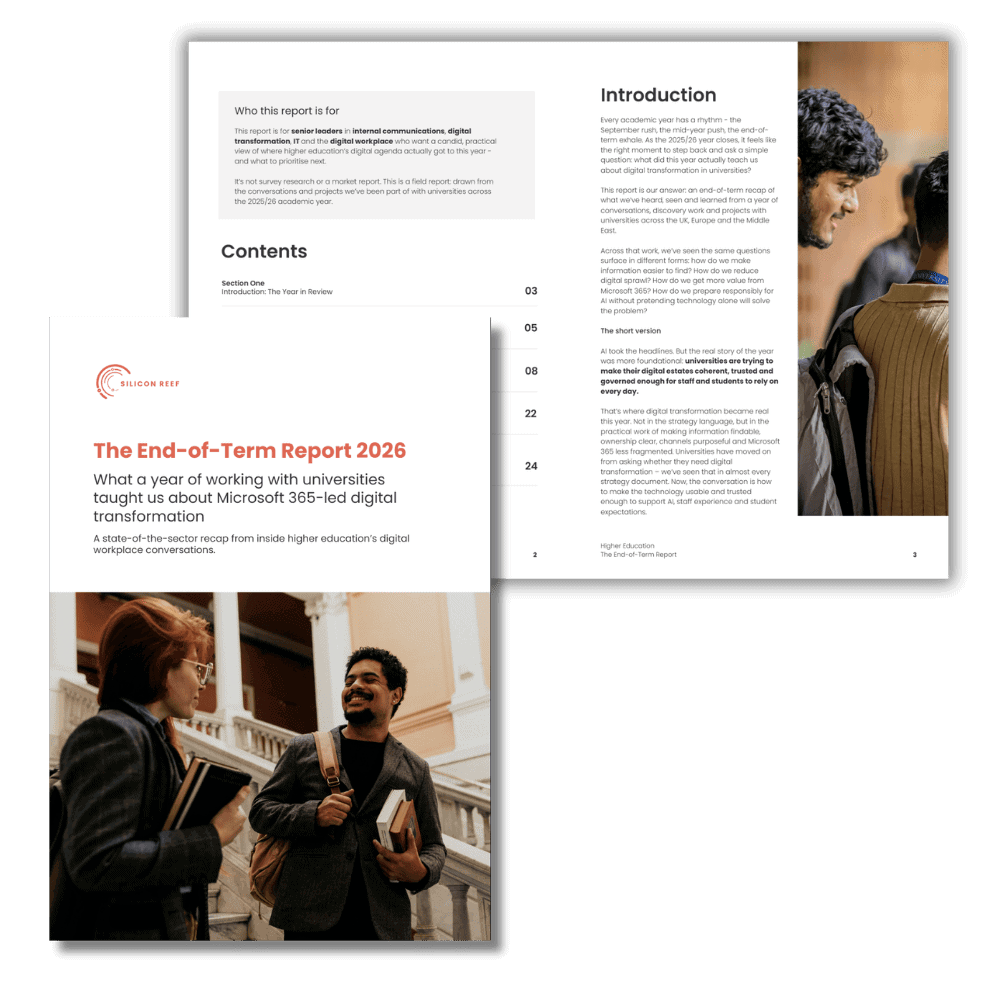
End of Term Report 2026: What a Year of Digital Transformation in HE Taught Us
Insights from a year of conversations and projects with universities across the UK, Europe and the Middle East – including the trends shaping digital workplaces across the sector, how universities are addressing key challenges and a look ahead to the future.