
Over the past few years, I’ve met countless people in organisations who are natural problemsolvers. They’re the ones redesigning spreadsheets that run entire departments or building small workflows that remove everyday frustrations. Lowcode technology has poured fuel on that kind of ingenuity, giving nontechnical people the ability to move ideas into action. It’s an exciting, empowering shift. Yet as energy increases, so does complexity – and without guidance, that energy can easily scatter rather than scale.
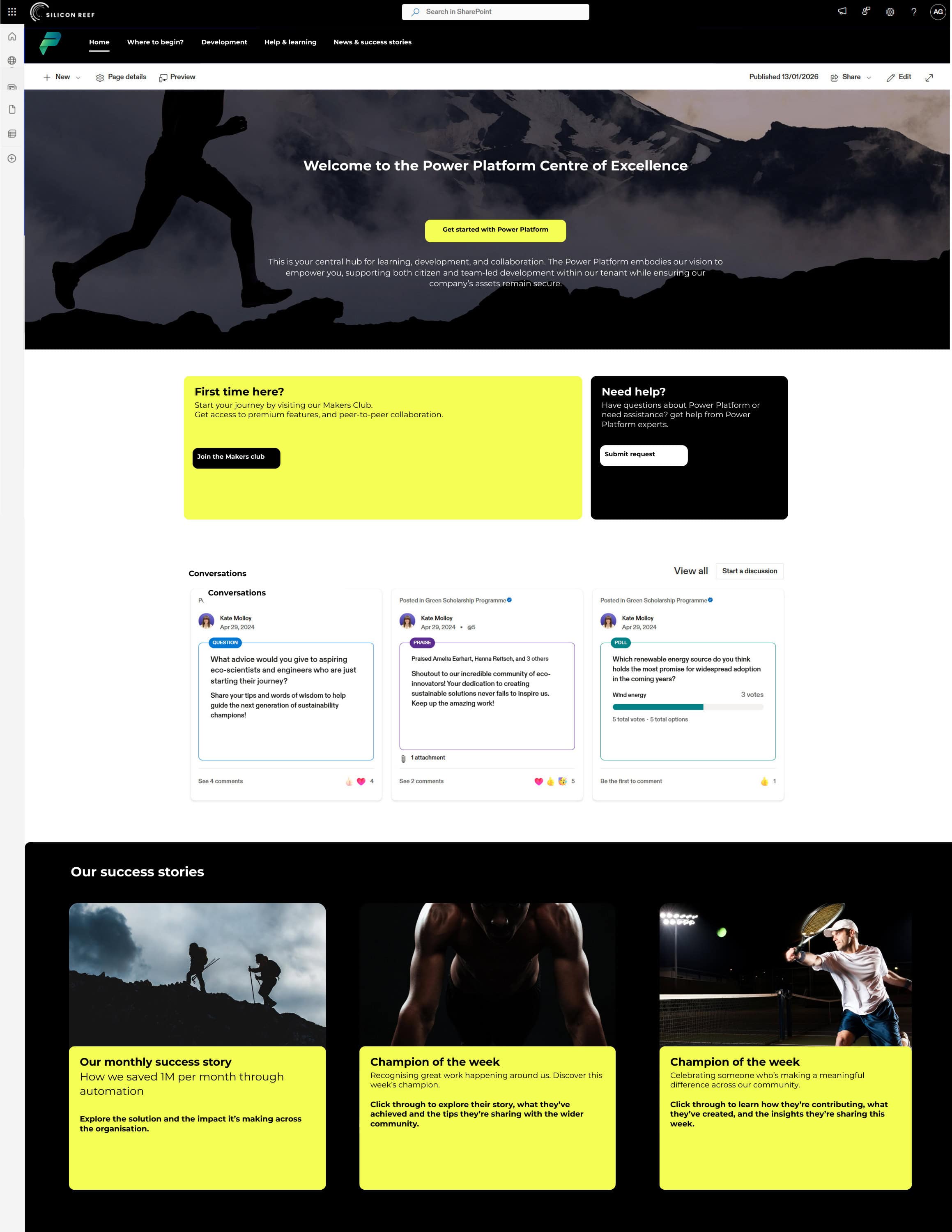
That’s where a Power Platform Centre of Excellence – the CoE – truly earns its name. A CoE isn’t designed to be a gatekeeper or a governance board; it’s a living function that keeps innovation safe, connected, and sustainable. In the simplest sense, a CoE is how an organisation tells its people: We trust you to improve things – and we’ll give you the structure, clarity, and confidence to do it well.
Why a Centre of Excellence Exists
At its heart, a CoE exists to help creativity grow responsibly. It’s not about policing ideas but creating the right environment for them to thrive. Left unchecked, lowcode platforms often turn into a jungle – rich in innovation but tangled with duplication, hidden dependencies, and real business risk. A CoE replaces that chaos with an ecosystem. It puts in place clear environments, sensible data policies, and easy access to templates, training, and support so that making something new feels natural, not nervewracking. People still have the freedom to build; they just do it on firm ground.
But the CoE’s role is more than organisation and governance. It’s a strategic connector. Every organisation has more inefficiencies and opportunities than its formal roadmaps can address. The CoE acts as a bridge between that untapped potential and the company’s strategic goals. It helps channel grassroots ideas toward projects that create measurable impact – the kind that align with business strategy and demonstrate visible value to leadership.
A wellfunctioning CoE also nurtures culture. It turns individual efforts into collective progress by encouraging community, mentorship, and celebration. It’s where makers share their successes, coach others, and feel part of something larger than a set of tools. That community is the engine behind cultural change – building confidence, collaboration, and a shared sense of ownership over digital transformation.
The Business Case for a Centre of Excellence
Many leaders worry that a CoE will slow things down – another layer of governance in a world that already moves fast. In practice, it does the opposite. By bringing structure and clarity to how people innovate, it removes the friction that causes waste and rework. One great app can become a standard pattern for five more. Reusable connectors and templates save hours of duplication. Sensible licence management stops value leaking from overspend. The CoE effectively multiplies return on effort by turning one success into many.
It also makes innovation faster and more trustworthy. When people know there’s a safe path to build – with established templates, guardrails, and training to help them – they move with confidence. Projects flow faster from idea to impact, because the foundations are already laid. That predictability builds confidence across the organisation: leadership trusts the outcomes, IT trusts the governance, and employees trust that they can build without breaking things.
Over time, the CoE becomes a strategic enabler, not a cost centre. It turns a set of isolated experiments into a scalable innovation capability. Beyond simply reducing risk or boosting efficiency, this approach enables a business to continually adapt, learn, and evolve through the hands of its own people.
The Human Case for a Centre of Excellence
While the numbers matter, it’s the people side of a CoE that changes an organisation most profoundly. When employees realise they can directly improve their own processes – without long wait times or complex approvals – it shifts the culture from dependency to empowerment. People start questioning how things could work better, and that mindset spreads. They become active participants in the company’s progress rather than passive observers of it.
A CoE also gives people psychological safety. It offers clarity around what’s possible, what’s supported, and how to get help when things go wrong. That sense of support means more ideas see daylight because people aren’t paralysed by risk. And as communities of makers form – through champion networks, showandtells, Viva Engage communities – people begin learning from each other. Recognition and shared pride become natural outcomes, and businesses start building a sense of belonging.
In practice, that human impact often shows up as:
- People volunteering ideas they’d previously kept to themselves.
- Managers encouraging experimentation rather than blocking it.
- Teams sharing solutions across departments instead of reinventing the wheel in isolation.
The Cost of Standing Still
Doing nothing is not a neutral choice. When lowcode creativity grows unchecked, organisations usually find themselves in one of two extremes. In the first – the “Wild West” scenario – innovation runs ahead of governance, leading to shadow IT, ballooning costs, and exposure to risk. In the second – the “Winter Freeze” – leadership reacts too strongly, halting experimentation altogether and dampening the very curiosity they wanted to encourage.
A welldesigned CoE prevents both. It provides just enough structure to direct innovation without smothering it. That balance – freedom within boundaries – is where healthy lowcode ecosystems live. It’s what keeps creativity confident instead of chaotic.
Centre of Excellence Meets Copilot
Up to this point, we’ve been talking about a Power Platform Centre of Excellence as the home for lowcode innovation – the place that supports makers as they build apps, automate workflows, and connect data. That foundation becomes even more important as generative AI tools like Copilot enter everyday work. AI sits alongside low-code, changing how ideas are created and delivered. And just as lowcode benefits from a Centre of Excellence, so does AI.
For leaders, the key questions become:
- How do we let AI and lowcode speed things up without losing control or clarity?
- How do we keep people accountable and engaged when machines can generate so much?
- How do we make sure AI and lowcode both support our values, not just our workloads?
Together, a mature Power Platform CoE and a mature AI/Copilot CoE give organisations a joinedup way to answer those questions and keep people at the centre of innovation.
What a Centre of Excellence Looks Like in Practice
Among our enterprise clients, we see a consistent pattern of success. Hundreds of new makers have emerged as confident creators, supported by training, templates, and communities of practice. Workflows that once consumed entire teams have been streamlined or automated, freeing time for highervalue work.
In our work with Warner Bros. Discovery, for example, the CoE became the backbone of a global lowcode ecosystem supporting tens of thousands of users. Together we introduced clear guardrails, a communitydriven enablement model, and a pipeline of highvalue use cases that showed the business what “good” really looked like. Apps like the Dataversepowered Hair & Makeup booking tool and a centralised TNT Sports dashboard replaced manual, spreadsheetheavy processes with intuitive experiences and a single source of truth – saving significant time and an estimated sevenfigure sum over four years. Because the CoE brought governance, design, and people together from day one, Warner Bros. Discovery could grow citizen development with confidence rather than caution.
Perhaps most striking across these programmes is the cultural shift: people start speaking the same language of improvement. Departments share ideas. Wins are celebrated openly. The business becomes more transparent and interconnected – a place where progress feels shared rather than siloed. That’s what a mature CoE delivers: not just working apps, but a working culture of innovation.
Bringing It Back to Work Happy
For us at Silicon Reef, a Power Platform CoE isn’t just a technical construct; it’s an expression of how you want your people to work and feel. It’s the difference between employees wrestling with rigid systems and employees shaping tools that genuinely help them do their best work. When you blend strong governance with humancentred design and a culture of shared ownership, you create a workplace where innovation feels natural, safe, and shared.
That’s what Work Happy looks like in the context of Power Platform: people at every level spotting opportunities, improving what’s in front of them, and knowing there’s a structure in place to support their ideas. A Centre of Excellence is simply the way we make that behaviour sustainable at scale – so your organisation doesn’t just keep up with change, it grows through it.
Explore More Real‑World Impact
Want to see how these principles come to life?